
The way to find fairly priced off-base Yokosuka homes for rent is to confirm your eligibility with the base housing office first, then compare listings across both military-focused and ordinary Japanese agents, and understand the upfront fees well enough to question them.
- Check with the Yokosuka housing office before you sign anything off base.
- Military-focused agents are convenient, but local Japanese agents often list the same neighborhoods.
- Expect upfront costs such as a deposit, key money, an agent fee and a guarantor company fee, and ask which ones are negotiable.
- Pick a neighborhood by your daily commute and train line, not by how close it looks on a map.
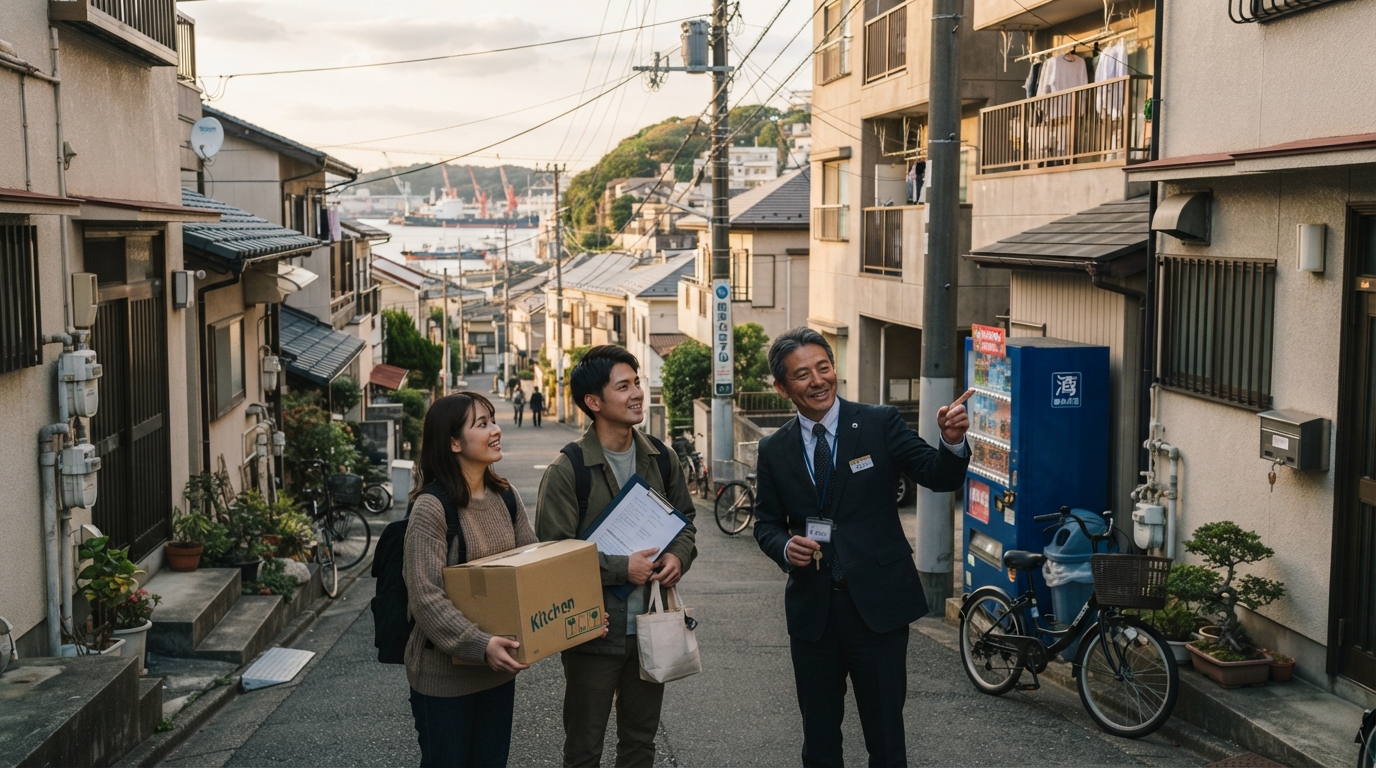
Where do off-base Yokosuka homes for rent actually get listed?
Off-base Yokosuka homes for rent show up in three places: through the base housing office, through agents who specialize in military tenants, and on ordinary Japanese rental portals and neighborhood agents.
The base housing office is the first stop because it can tell you whether you are cleared to live off base and what support comes with that. Military-focused agents are the easiest second step: they speak English, know base paperwork and are used to tenants arriving on orders. The trade-off is that the most convenient channel is not always the cheapest one. Many of the same apartments and houses near Yokosuka-Chuo, Shioiri, Taura or Zushi are also listed by local Japanese agencies, sometimes on plainer terms.
When we help military families look across Yokosuka, Yokohama and Zushi, the most common surprise is how much of the market sits outside the English-language listings. Seeing both sides before you commit is the simplest way to tell whether a quoted rent is fair.
How do Japanese rental agents, guarantors and contracts work?
In Japan, the agent usually handles the viewing, the application and the contract, while a guarantor company stands behind your rent on the landlord's behalf.
Most foreign tenants do not have a Japanese relative or employer to act as a personal guarantor, so landlords typically ask you to enroll with a guarantor company instead. You pay that company a fee; if rent goes unpaid, it pays the landlord and then collects from you. The GTN Magazine guide to how renting in Japan works walks through guarantors, upfront costs and tenant screening for foreigners from the ground up, and it is worth reading before your first viewing.
Read the contract type carefully, too. As the Migaku guide to Japan rental contract terms notes, knowing which kind of lease you are signing matters because the renewal rights are completely different. If your orders could be extended, ask the agent directly whether the lease can be renewed.
What move-in costs should you expect, and which can you push back on?
Expect to pay several separate charges before you get the keys, and treat each one as a line item you are allowed to ask about.
- Security deposit (shikikin): held by the landlord and partly returned after move-out, minus cleaning and repairs.
- Key money (reikin): a non-refundable payment to the landlord. Some landlords waive it, especially for units that have been empty a while.
- Agent fee: paid to the agency that arranges the contract.
- Guarantor company fee: an initial fee, and often a renewal fee later.
- Other charges: lock replacement, cleaning, fire insurance and the first month's rent are common additions.
The expat markup usually hides in these extras rather than in the monthly rent. Ask for an itemized estimate in writing, compare it with a second agent's estimate for a similar unit, and ask whether key money can be reduced. One cost you may be able to avoid: the Yokosuka housing page on Military OneSource says the Housing Self-Help office can provide Japanese appliances for off-base rental quarters if the owner or landlord has not already installed them.
Which neighborhoods balance commute time and price?
The best-value neighborhood is the one on a train line or bus route that gets you to the gate reliably, not necessarily the one closest to it.
Areas right around Yokosuka-Chuo and Shioiri put you within walking distance of the base and the city center, and rents there reflect that convenience. Moving a few stops along the Keikyu or JR lines, toward areas such as Taura, Kinugasa or Oppama, often gets you more space for the money. Zushi trades a longer commute for a beach town feel, and some families look as far as Yokohama for schools, shopping and city life.
When we compare options with families, we look at the full door-to-gate trip at the hour they would actually travel, including the walk to the station and any transfer. A cheaper house that adds a transfer every morning is not always the better deal.
How do you search when listings are mostly in Japanese?
You can search Japanese listings yourself with a browser translation tool, then bring the specific properties to an English-speaking agent to arrange viewings.
Learn a handful of terms so you can filter quickly: the floor-plan codes such as 1LDK or 3LDK, the walking minutes to the nearest station, and labels showing whether pets are allowed. Save the listing pages, because the same unit can appear with different agents. When a military-focused agent quotes a much higher rent than a Japanese listing for what looks like the same property, ask them why before you sign.
Looking for Yokosuka homes for rent from overseas is easier when you arrive with a short list, a budget that includes the move-in costs above, and clear answers from the housing office about what you are allowed to rent.